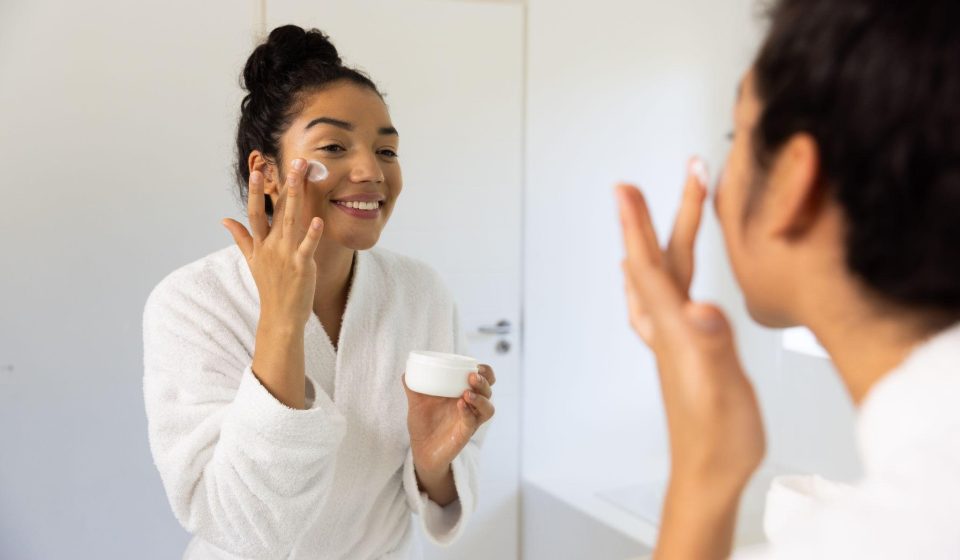

A skin clinician once put it bluntly during a consultation: the average adult face makes approximately 15,000 muscle movements per day. Each contraction transmits mechanical force through subcutaneous tissue, pulls on dermal collagen, and over years leaves behind the linear creases dermatologists categorize as dynamic wrinkles. That figure, originally surfaced in the technical literature published by Biologique Recherche, is the kinematic foundation of an entire product subcategory now occupying shelf space in clinical spas across North America.
The category goes by various names, myorelaxant skincare, peptide-based expression line treatment, topical neuromuscular cosmetics, and its commercial flagship is a small ivory jar labeled Crème Biofixine. The product has been on the market for years, but the science behind it has only recently entered mainstream conversation.
The peptide at the centre of the formula
Acetyl Hexapeptide-8 and its mechanism
The active ingredient most often credited for the product’s results is Acetyl Hexapeptide-8, listed in the Biologique Recherche literature under the proprietary descriptor Myorelax Peptide. It is the same molecule that Lipotec commercialized in 2001 under the brand name Argireline. The peptide is a synthetic chain of six amino acids designed to mimic the N-terminal sequence of SNAP-25, a protein involved in the synaptic vesicle docking process required for acetylcholine release at the neuromuscular junction.
In simpler language: the peptide competes with SNAP-25 for binding within the SNARE complex. When that competition succeeds at the topical level, acetylcholine release is partially inhibited, which means the affected muscle fibres contract with less force. Botulinum toxin (Allergan’s Botox) accomplishes the same downstream outcome through a different mechanism, proteolytic cleavage of SNAP-25, but with vastly greater potency and a route of administration that requires a needle and a prescribing clinician.
What the in vivo data shows
Independent studies on Acetyl Hexapeptide-8 at 10% concentration have reported wrinkle depth reductions in the 17–30% range over four to eight weeks of twice-daily application. Brand-specific data published by Biologique Recherche cites a 20% reduction in forehead expression lines and a 22% reduction in smile lines, measured by silicone-replica profilometry over a comparable treatment period. For more detailed product positioning and the company’s published methodology, refer to Crème Biofixine by Biologique Recherche, which lists the formulation’s complete active complex.
These numbers should be read carefully. Profilometric reduction is not the same as visual smoothing perceived in a mirror, and 20% reduction of an already-shallow line is cosmetically more impressive than 20% reduction of a deep static wrinkle. The peptide does not erase wrinkles already set into the dermis by years of collagen and elastin attrition. What it does is reduce the depth of contraction-driven creases, the kind that appear when the face moves and persist briefly afterward.
The supporting active complex
Why the peptide is rarely alone
Acetyl Hexapeptide-8 in isolation has limited topical bioavailability. The molecule is hydrophilic and relatively large, which means stratum corneum penetration is the rate-limiting step. Formulators address this with delivery vehicles, propylene glycol, pentylene glycol, polysorbate-40, and with co-actives that address the surrounding contributors to wrinkle formation.
In Crème Biofixine, the supporting cast includes several extracts worth identifying by function:
- Walnut seed extract (Juglans regia): a juglone-rich antioxidant with documented inhibitory effects on tyrosinase and elastase, contributing to mild brightening and elastin preservation.
- Edelweiss flower extract (Leontopodium alpinum): contains leontopodic acid, a polyphenol with free radical scavenging activity comparable to vitamin E in some in vitro models.
- Green anise extract (Pimpinella anisum): the brand’s “botanical tensing agent,” delivering an immediate optical firming effect through evaporative film-forming chemistry.
- Grape seed oil (Vitis vinifera): rich in linoleic acid and proanthocyanidins, restoring barrier lipids while delivering antioxidant defence.
- Watercress extract (Nasturtium officinale): mentioned in the brand’s technical materials as part of the anti-wrinkle complex, contributing isothiocyanate-mediated antioxidant activity.
The formula also contains the brand’s proprietary BR Oxygenating Complex, the composition of which is not fully disclosed, and a small amount of white clay (kaolin) for textural finish and mild purification. The base structure is a stearic-acid emulsion with glycerin and butylene glycol acting as humectants, preserved with phenoxyethanol, p-anisic acid, and benzoic acid.
How the product compares to peptide alternatives
The peptide skincare category now spans three distinct price tiers, and understanding where any given product sits clarifies what to expect from it.
At the entry tier, products like The Ordinary’s Argireline Solution 10% deliver the peptide in a simple aqueous base with minimal supporting actives. Cost is low. Texture is utilitarian. Results, in published consumer trials, are modest but measurable.
In the mid-tier, mainstream brands like Olay Regenerist and Neutrogena Rapid Wrinkle Repair include peptides as part of broader anti-aging formulas typically built around retinol or niacinamide. Peptide concentration is rarely disclosed.
At the professional tier, products like Crème Biofixine, ZO Skin Health’s Growth Factor Serum, and SkinCeuticals’ A.G.E. Interrupter combine peptides with supporting complexes specifically formulated for esthetician-supervised use. Cost rises significantly. The trade-off being purchased is not just concentration but formulation sophistication.
Where the cream sits in a routine
The brand’s published protocol places Crème Biofixine after cleansing with Lait U or Lait VIP O2, application of the appropriate Lotion P50 variant, and a Sérum Authentique or Sérum Booster matched to the user’s diagnosed Skin Instant. The cream is applied morning, evening, or both, with a hazelnut-sized portion massaged into the face, neck, and décolleté using upward strokes.
That sequencing matters because the peptide’s penetration depends on the barrier state of the skin underneath it. P50 prepares the surface by exfoliating, rebalancing pH, and increasing receptivity to actives applied afterward. Serums deposit smaller-molecule actives. The cream seals the routine and delivers the peptide complex into an already-primed substrate.
Used outside that sequence, applied to unprepared skin, layered under occlusive sunscreens before absorption, or alternated with strong retinoids on the same evening, the cream’s measurable effect drops. That is not a flaw in the product. It is a consequence of how peptide chemistry interacts with skin biology, and it explains why brands in this tier remain stubbornly attached to esthetician-led recommendation rather than self-service retail.
Realistic expectations and timeline
Clinical studies on topical Acetyl Hexapeptide-8 generally report measurable effects beginning around the four-week mark, with stronger results visible between weeks eight and twelve. This is consistent with the cell turnover cycle and with the cumulative nature of peptide signalling, single applications produce minimal change, while sustained daily use compounds the effect on dermal architecture over months.
Users who expect botulinum-toxin-equivalent results will be disappointed. Users who expect mild but consistent reduction in expression line depth, alongside improved skin texture from the supporting complex, will generally find the data supports the experience. The two product categories are not substitutes for each other. They occupy adjacent positions on the same intervention spectrum, with different mechanisms, costs, and risk profiles. Read together, the peptide and injectable categories are complementary tools for the same problem, not competitors.